
Your Cart Is Empty
✖No products in the cart.

What Clients Notice in Their First Week With a VA
August 14, 20265 Signs Your Business Has Outgrown the Way You Currently Operate
September 11, 2026What Clients Notice in Their First Week With a VA
August 14, 20265 Signs Your Business Has Outgrown the Way You Currently Operate
September 11, 2026
For a long time, the traditional 9–5 defined how people worked. You got dressed, battled traffic, arrived at the office, worked from your desk, and headed home at the end of the workday.
Now, more professionals are asking a different question: Do I really need to be in an office to do my job well?
For many employees, business owners, and even hiring managers, the answer is increasingly no.
Remote work has moved from a perk that only a handful of progressive companies offered to a serious way of structuring work. It has changed how people think about productivity, hiring, flexibility, and even what a good job looks like.
That does not mean the traditional 9–5 is disappearing. Some roles genuinely benefit from being in the same physical space. But remote work is winning the preference of many professionals for reasons that go far beyond working in pajamas.
Ask someone why they want a remote job and “I don’t want to commute” will probably come up quickly.
And fair enough.
For many professionals, commuting can take hours out of the day.A person might spend two hours getting to and from work, only to spend eight hours at a desk doing work they could have completed from home.
Remote work gives people some of that time back.
That extra time can mean having breakfast with your family, getting some exercise, studying, handling personal responsibilities, or simply getting enough rest before another workday begins.
But flexibility goes beyond location.
A well-structured remote role can give employees more control over how they organise their day. Someone who works best in the morning can tackle demanding tasks early. Another person might use a quiet afternoon to focus without the interruptions that often come with a busy office.
The important distinction is that flexibility should not mean a lack of structure. Remote teams still need deadlines, communication standards, accountability, and clear expectations.
Salary still matters, in fact, a lot. But professionals are increasingly looking at the entire working experience when deciding whether a job is worth taking.
Can I work from where I am most productive?
How much time will I lose commuting?
Will I have some control over my schedule?
Can I work for a company outside my city or country?
Will my employer judge my performance by the hours I sit at my desk, or by the quality of my work?
These questions are changing the competition for talent.
A company offering a slightly higher salary but requiring a long daily commute may not automatically be more attractive than one offering remote work, flexibility, and a supportive working environment.
For employers, this is worth paying attention to. The benefits you offer are part of your talent strategy.
This may be one of the biggest advantages for businesses.
A traditional office setup often limits hiring to people who can reasonably commute to that location. Remote work removes much of that geographical restriction.
A business in Lagos can work with a virtual assistant in another Nigerian city. Startups, meanwhile, can find specialists based in different countries. Growing companies can also access skills that may not be readily available within their immediate area.
That creates opportunities on both sides.
Businesses get access to a broader pool of talent, while professionals can now pursue opportunities beyond their immediate location.
For startups and SMEs in particular, this can be valuable. Instead of immediately building a large in-house team, a business can bring in remote professionals to support specific functions such as administration, customer support, social media, bookkeeping, research, lead generation, or executive assistance.
The focus shifts from “Who is available near us?” to “Who is the right person for this role?”
This is where the conversation needs a little honesty. Remote work has its own challenges.
Some people struggle with distractions at home. Others miss the social interaction that comes with an office. Poor communication can become a serious problem when team members are working from different locations and nobody knows who is responsible for what.
There is also the risk of blurred boundaries.
When your office is in your home, it can be surprisingly easy to check “one last email” at 9 p.m. and realise an hour later that you’re still working. So the success of remote work depends heavily on how it is managed.
A remote company with unclear responsibilities, endless meetings, poor communication, and no respect for employees’ time can be more stressful than a traditional office. The location is not the whole solution.
The way work is organised matters just as much.
If a company wants remote work to actually work, it needs more than Zoom calls and a WhatsApp group.
Employees should know what they are responsible for, what deadlines matter, and how their performance will be evaluated.
Not every issue needs a meeting. Not every message needs an immediate response either.
Remote teams need clear communication channels and agreed ways of sharing updates, asking questions, and escalating problems.
Micromanaging someone’s online status is not the same as managing performance.
Good remote teams focus on results. Did the task get done properly? Was the deadline met? Was the client supported? Did the employee communicate when there was a problem?
Those questions are more useful than constantly checking whether someone is sitting in front of their laptop.
Remote work requires a level of independence. Professionals need to manage their time, communicate clearly, stay organised, and take responsibility for their work.
That makes hiring for remote positions slightly different from simply hiring for an office.
Technical skills matter, but so do reliability, communication, initiative, and the ability to work without someone standing over your shoulder.
Not necessarily.
There are industries and roles where physical presence remains important. Some teams also perform better when they have regular face-to-face interaction.
The bigger shift is that people now have more options.
The old assumption was that work had to happen in a particular place and during particular hours. Remote work has challenged that assumption.
And once people experience the benefits of eliminating unnecessary commuting, accessing wider career opportunities, and having more control over their working environment, going back to the old model simply because “that is how things have always been” can feel difficult.
For businesses, the lesson is not that every company should become fully remote.
The real goal is to design work around what helps people and businesses perform well.
Some organisations may work best with fully remote teams. Others may prefer a hybrid model, while certain roles may still make perfect sense in a traditional office.
The future of work is likely to be less about choosing one model for everyone and more about finding the model that actually fits the work.
Remote work is winning over the traditional 9–5 because it offers something many professionals now value highly: greater flexibility without necessarily sacrificing productivity.
For businesses, it also creates access to a wider talent pool and new ways to build lean, capable teams.
But remote work is not a magic solution. It works when businesses have the right systems, people, communication, and expectations in place.
The real question isn’t simply “Should we work remotely or from an office?”
It is “What kind of working environment allows our people and our business to do their best work?”
That is a much more useful conversation.
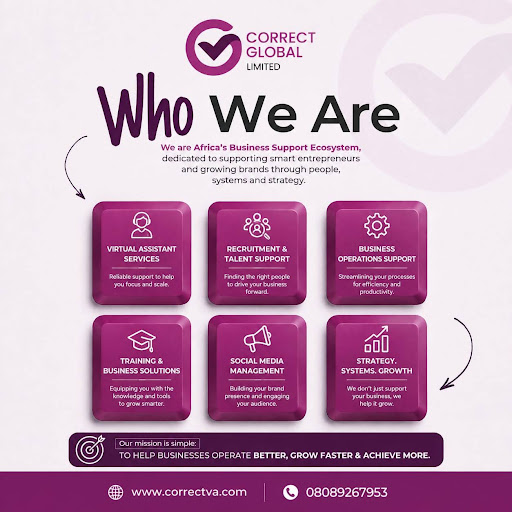
For businesses looking to build reliable remote teams or professionals looking to develop the skills needed to thrive in remote work, Correct Global Limited helps bridge that gap through virtual assistance, talent solutions, and professional development. The right people and the right structure can make flexible work.
No products in the cart.