
Your Cart Is Empty
✖No products in the cart.

Remote Work Is Winning Over the Traditional 9–5
August 21, 2026Remote Work Is Winning Over the Traditional 9–5
August 21, 2026
A business can grow faster than its business operations can handle. The team gets bigger, customers increase, responsibilities multiply, and suddenly the way you used to get things done starts creating problems.
The founder who once handled every customer message can no longer keep up. A small team that once communicated easily now spends too much time asking who is responsible for what. Simple approvals take days. Customers follow up twice before getting a response.
The business may still be making money. People may still be busy. From the outside, everything can look fine.
But inside, the cracks are becoming harder to ignore.
This is often what happens when a business outgrows its way of operating. The problem isn’t necessarily that the business is doing badly. In many cases, growth itself has exposed weaknesses that were easy to overlook when the team was smaller and the workload was lighter.
Here are five signs that may be happening in your business.
When a business is small, the founder naturally becomes the centre of almost everything.
They answer difficult customer questions, approve expenses, review documents, assign tasks, speak to vendors and make the final call on even relatively minor decisions.
At some point, that stops being practical.
If your team regularly waits for you before moving forward, you have become a bottleneck, even if everyone is working hard.
A founder might spend an afternoon approving social media content, checking routine emails and answering questions their team could handle themselves. By the end of the day, routine tasks have taken up the time the founder needed for planning, building partnerships, developing new opportunities, and making important financial decisions.
That is not a motivation problem. It is a structure problem.
Growing businesses need clearer ownership. People should know what they can decide independently, what requires approval and who is responsible for each part of the workflow.
Being busy is not the same as being productive.
A team can spend eight hours working and still finish the day with unanswered emails, unfinished reports, pending follow-ups and customers waiting for updates.
Look closely at where your team’s time goes.
Are skilled employees spending hours scheduling meetings, organising files, responding to routine enquiries, or chasing information from different people? Do small administrative tasks keep pulling them away from important projects?
These tasks may seem harmless individually. Collectively, they can consume a surprising amount of capacity.
This is where delegation becomes important.
Not every task needs to sit with the person who has the most expertise. A finance professional should have time to focus on financial analysis rather than spending half the morning coordinating calendars. A sales lead should be developing opportunities, not manually compiling routine spreadsheets all day.
Sometimes the business does not need more employees yet. It needs to use the capacity it already has more intelligently and bring in the right support where there are genuine gaps.
Customers don’t see your workflow.
They don’t know that your operations manager is waiting for information from the sales team or that the person handling their enquiry has five other urgent tasks.
They simply experience the result.
A delayed response. A missed follow-up. Having to repeat the same information. Being transferred from one person to another. Promises that aren’t followed through.
One missed message might not seem significant. Their patterns are different.
Customer experience is often a reflection of internal operations. When responsibilities are unclear or information is scattered across different people and platforms, customers eventually feel the impact.
Pay attention to repeated complaints and recurring questions. They can reveal operational problems that aren’t obvious when you’re looking at the business from the inside.
If customers keep asking, “Has there been an update?” your problem may not be customer service alone. There may be a gap in your follow-up process.
The process that worked perfectly when you had ten clients may not work when you have fifty.
You might have once managed enquiries through a shared WhatsApp account, or kept client information in a simple spreadsheet, or better still have remembered important deadlines without a formal system.
That can work for a while.
Then the business grows.
Suddenly, two people contact the same client. A deadline gets missed because nobody recorded it. A document is difficult to locate. A new employee has no idea how a particular task is supposed to be done.
This is usually a sign that the business needs stronger systems, not more improvisation.
Good business operations should make work easier to repeat, track and hand over. That could mean documenting processes, assigning clear responsibilities, improving project management systems or creating better methods for handling customer information.
The goal is not to make a small business unnecessarily complicated. It is to make sure the business can keep functioning even when one person is unavailable.
This is one of the easiest traps to fall into.
The workload becomes too much, so the immediate response is: “We need to hire someone.”
But what exactly does that person need to do?
If the answer includes twenty unrelated responsibilities, the business may not have defined the problem properly.
A company might advertise for an administrative officer when what it really needs is dedicated customer support. Another might hire a full-time employee to handle tasks that remote support could manage. A growing team might keep recruiting when the bigger issue is poor workflow design.
Before opening a job vacancy, it is worth asking:
Then ask:
That distinction matters.
The right solution should fit the actual need of the business rather than simply adding another person to an already unclear system.
Business growth is exciting, but it also changes the demands placed on the people and systems behind the business.
What worked with a small team may become inefficient at a larger scale. Informal communication may need structure. Responsibilities may need to be redistributed. Some tasks may need to be delegated, automated or supported by additional talent.
The important thing is to notice these changes before they become expensive problems.
If your business is constantly reacting to delays, overloaded employees, missed opportunities or founder bottlenecks, it may be time to take a closer look at how work currently gets done.
Sometimes the next stage of growth does not begin with doing more.
It begins with operating differently.
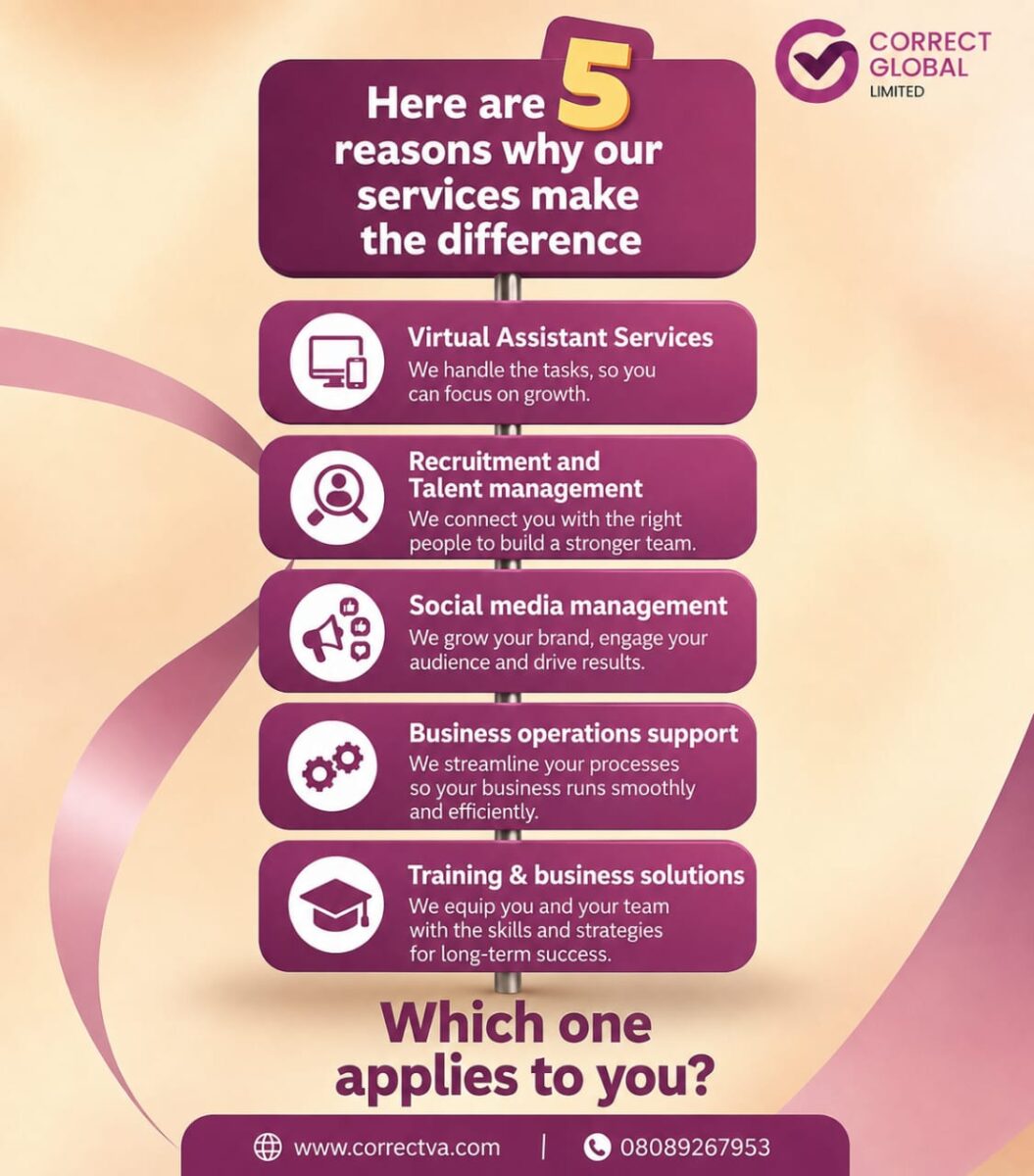
Correct Global Limited works with businesses to identify gaps in their people, processes and day-to-day operations, then explore practical solutions, from talent acquisition and virtual business support to training and broader business solutions.
If you’re unsure where your current challenges are coming from, a conversation with the right support partner can be a useful place to start.
No products in the cart.